
By: Amanda Guarragi
In the 1800s, Norwegian playwright Henrik Ibsen premiered his play “Hedda Gabler” in 1891. Ibsen’s work primarily focused on modern drama, and he wrote more realistic plays. The character of Hedda Gabler explored a woman’s resentment for being trapped in a marriage and a house she never wanted.
Hedda Gabler is considered the more complex role for any actress to portray due to the depth of her moral values. Ibsen highlighted this duality through her married name, “Tesman,” and her maiden name, “Gabler,” creating an internal struggle in her life before and after marriage. It reflects the woman she once was versus the woman she was compelled to become because of societal expectations of women.
Even though she is the title character, the tension arises in Hedda Gabler when her husband’s academic rival, Eilert Lovborg, reappears, threatening his promotion as his competitor for a professorship at the local University. The conflict and sexual tension are between Hedda and her husband’s rival, as they were former lovers. Hedda attempts to foil any chance her former lover has to secure the professorship to keep her future intact.

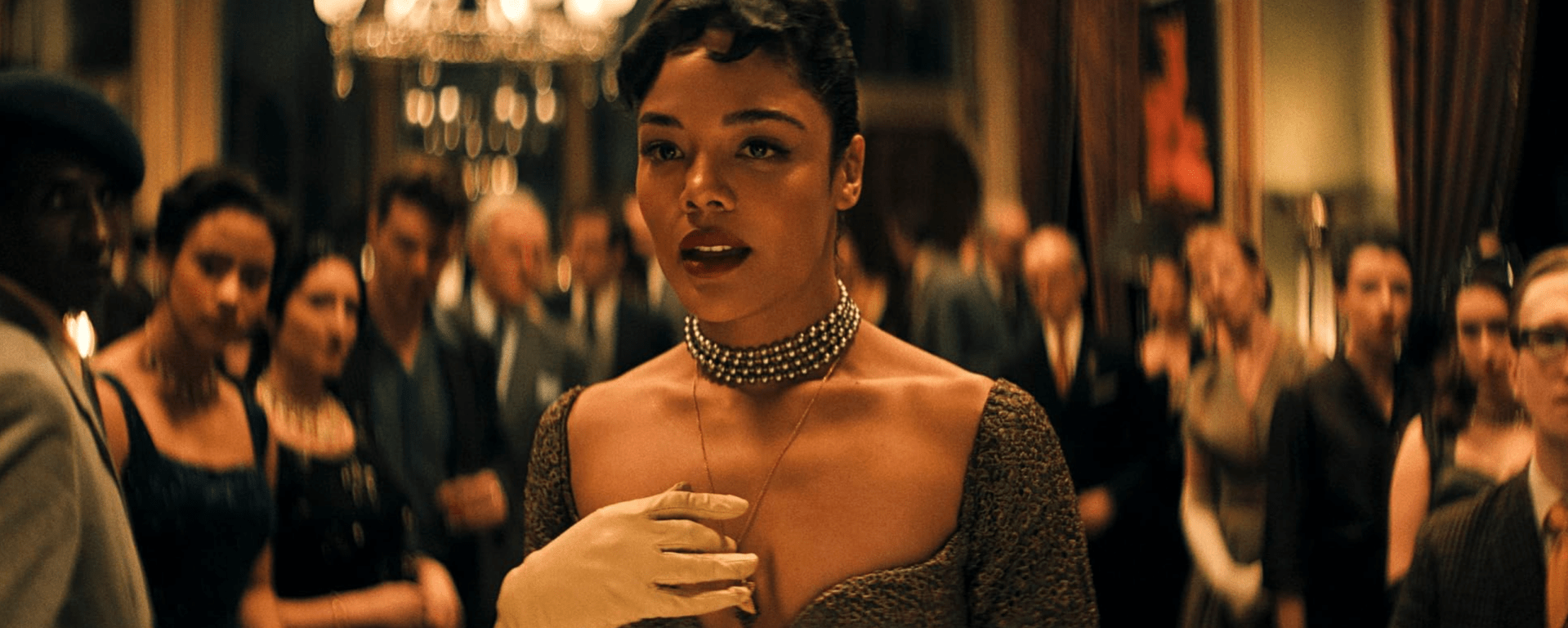
In Hedda, written and directed by Nia DaCosta, she modernizes and reimagines the story of Hedda Gabler, allowing depth and complexity to the titular role. Tessa Thompson ferociously devours the portrayal as casting a Black woman alters the societal elements of the story. Additionally, the gender reversal of Lovborg (Nina Hoss) adds another layer to Hedda’s battle with her former self as her bisexuality is challenged when Eileen enters her life once again after a tumultuous affair.
DaCosta dives deep into Hedda’s mind as we see her cunning nature in every decision she makes. As George Tesman’s (Tom Bateman) wife, the only thing she can ever look forward to is a fabulous party.
In preparation for one wild evening, DaCosta gives the audience glimpses of the darkness within her during intimate moments when she is alone with her thoughts. Whether it’s fooling around with a revolver or coming out of the lake fully clothed, DaCosta shows that Hedda is uncomfortable with her situation and continuously wants to escape.

DaCosta crafts a five-act structure showing Hedda’s descent into chaos and losing herself completely when her former self overtakes her. At each turn of an idea, Hildur Guðnadóttir’s sharp music cues a breath combined with string instruments, somehow creating a sensuality for Hedda and the mischievousness she’s capable of. It’s not overused throughout, but enters sharply before the beginning of the next act.
Thompson plays with both sides of Hedda in a feline way as she moves through crowds and charms her guests at every turn. Her sexuality is on full display as everyone invited knows how playful she had been in her maiden life. DaCosta also has Hedda save women who are feeling trapped in their marriages, so Hedda plays matchmaker during her party as well. Hedda ultimately places her pawns to her advantage to advance and keep her husband George on the track for greatness, even if she can’t fulfill her desires.
When Eileen Lovborg enters the party looking rejuvenated and put together, Hedda is taken aback by her beauty. The sexual tension between Nina Hoss and Tessa Thompson was electric, and every moment between them became richer than the next. The love-hate relationship between them worked wonders as Hedda got back at her for breaking her heart.

Not only does DaCosta enrich Hedda’s character, but she does the same for Eileen, who has been the sole woman in a boy’s club who constantly has to prove her intelligence. When Hedda finds out that Eileen has a mistress, she does not stop until her work and reputation are ruined. By ruining Eileen, Hedda also destroys a part of herself that will always be associated with her hidden identity and freedom.
Nia DaCosta’s Hedda is a dark, sexy and cunning period piece that explores female identity during a period of restraint and control. The opulent production design and stunning wardrobe elevate the sultry atmosphere, and even with its richness, it still feels like a masquerade because the characters are all hiding their authentic selves. DaCosta’s changes to the source material enrich the story for women, making this one of the best adaptations of Hedda Gabler.
 Candid Cinema