
By: Amanda Guarragi
As little girls, the dream was to become an adult as quickly as possible. Many have been inspired by models, actors, and family members, but without realizing it, the Barbie doll shaped an entire generation of young women who have paved the way for their daughters. The doll was created by Ruth Handler in 1959 and was incredibly successful heading into the mid-90s. However, the tide shifted on Barbie, and instead of the doll being an inspiration to young girls because of the different occupations that were marketed, the slender figure and beauty expectations challenged the original idea of the doll. After watching Greta Gerwig’s Barbie, there is a new appreciation for what the doll meant for many young girls during the peak time in sales for Mattel. In a way, this film showcases the original meaning of the doll after two decades of public scrutiny because of how damaging her look was.
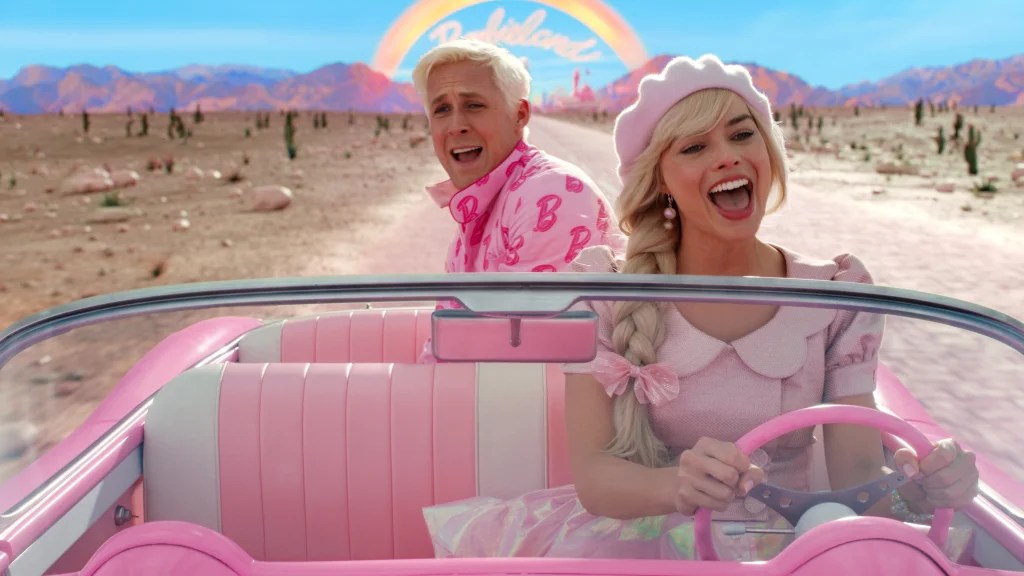
Writer-director Greta Gerwig made a whimsical feminist piece that addressed the current socioeconomic climate through the eyes of Barbie (Margot Robbie). Everyone in Barbieland lives peacefully because all the women run the land as efficiently as possible. Many Barbies are introduced, and they live happily in their alternate reality. Until one day, the stereotypical Barbie, played by Robbie, has this overwhelming sense of dread. Her heels become flat, and she is forced to head into the real world to see if her human has transferred their feelings to the doll while playing with her. Barbie crosses the “portal” with Ken (Ryan Gosling) by her side, and they see how different the world is on the other side. Ken is sucked into the patriarchy. The real world caters to men, while Barbie feels uncomfortable and out of sorts because that world doesn’t feel safe to her.
Even though Gerwig attempts to change the “fish out of water” narrative to cater to the role reversal of Ken and Barbie, the execution of the social commentary is flat in the second act. The conversations about women’s autonomy, the patriarchy, gender equality and a safe working environment are all important when discussing what Barbie was meant for. However, those conversations do get lost because the story with Ken gets away from Gerwig in the third act. There are some strong aspects when Barbie goes into the real world and notices the shift of how women are treated versus how men are treated through Ken’s perspective. Their relationship becomes less artificial and more human because they begin to understand their gender roles in reality. Not only does Barbie undergo an existential crisis about her place in this life, but Ken also goes through a pretty toxic masculine journey because of the system that supposedly caters to men. It’s unexpected to see that Ken is the antagonist of Barbie’s story in Barbieland, but it ultimately makes for an interesting conclusion for both characters.
Gerwig’s Barbie is far-fetched but still grounded in the themes presented through the the perspective of the doll. We see it from all angles, as consumers and as women. Gerwig balances the original meaning of the product while crafting a heartfelt and relevant narrative that humanizes the coming-of-age journey of Barbie. Apart from the sharp script by Gerwig and the incredible production design, the ensemble came together to make a unified Barbieland. Gosling’s performance is one to be remembered, while Robbie’s endearing rendition of Barbie is the heart of this film. Additionally, America Ferrera, who plays Gloria — the stereotypical Barbies owner — has an incredible monologue that will leave you stunned in the theatre. Even though there are some inconsistencies throughout, Barbie will draw you in with the campy fun of it all but will make you re-evaluate who you are and the role you play in life.
 Candid Cinema
3 thoughts on “‘Barbie’ Review”